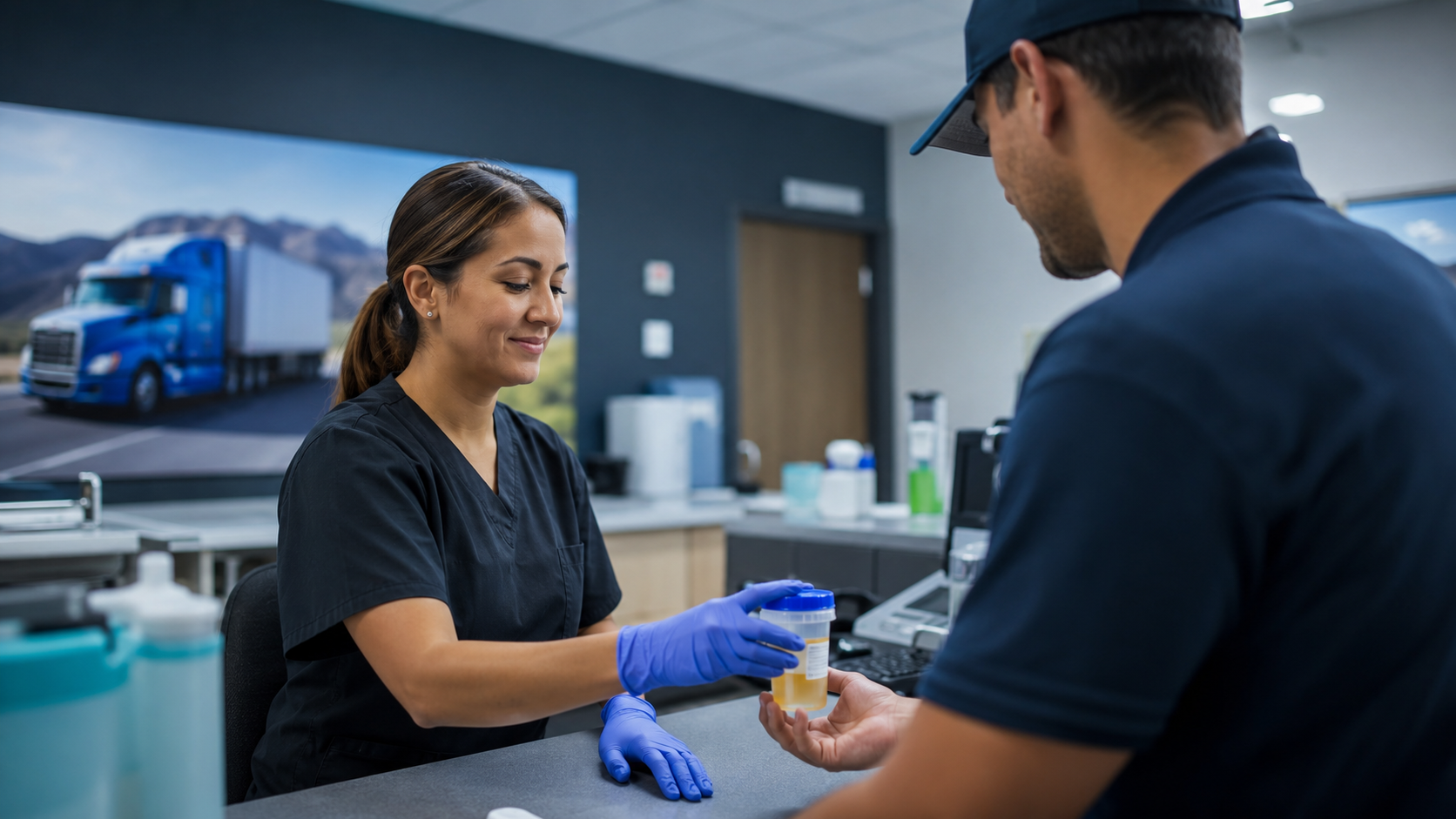
Certified technicians
Screening and confirmation performed by trained BATs — and by STTs where a screening test technician is permitted.
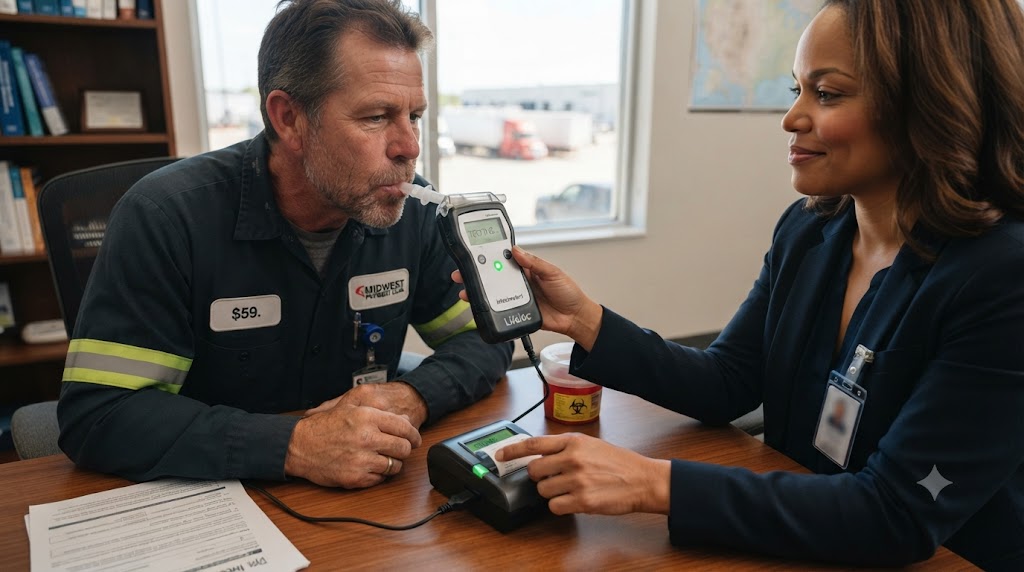
Post-accident alcohol testing has an eight-hour window. Certified BATs, evidential devices and a 24/7 line that a person actually answers — because this one cannot wait until Monday.
It runs on a different procedure, a different device, a different qualified technician and — critically — a much tighter clock. A DOT alcohol test must be performed by a certified Breath Alcohol Technician (BAT) on an evidential breath testing device from the approved conforming products list, following a screening test and, where the screening reads 0.02 or higher, a confirmation test after a mandatory waiting period.
Results are immediate. There is no laboratory and no MRO verification for a breath alcohol test — which is exactly why the procedure has to be right the first time.
| Confirmed result | Status | Employer action |
|---|---|---|
| Below 0.02 | Negative | Employee may perform safety-sensitive duty |
| 0.02 – 0.039 | Not a violation, but disqualifying | Immediate removal for at least 24 hours |
| 0.04 and above | Violation | Immediate removal, Clearinghouse report, SAP process required |
The 0.02 trap. A result between 0.02 and 0.039 is not a DOT violation — but the employee still must not perform safety-sensitive functions for at least 24 hours. Carriers who let a driver finish the shift on a 0.03 create a finding out of a result that was not one.
When an accident meets the DOT criteria, alcohol testing must be conducted within 8 hours and drug testing within 32 hours. If you cannot test within 2 hours, you must document why and keep trying. If you have not tested within 8 hours, you must stop attempting and prepare a written record of why the test was not performed.
That record matters as much as the test. Investigators look for it. Our 24/7 emergency line exists for precisely this scenario: call, and we locate a site with a certified BAT near the accident and generate the paperwork while you are still on the phone.
Note that alcohol testing is only permitted just before, during, or just after the performance of a safety-sensitive function. Testing outside that window is not a valid DOT test.
Outside DOT authority you set the threshold and the consequences. Breath testing is the usual choice for post-incident and reasonable suspicion. EtG urine testing is available where you need a longer lookback — it can detect alcohol metabolites well after breath testing would read zero, which suits abstinence-monitoring policies.
The details that decide whether an alcohol test holds up.
Screening and confirmation performed by trained BATs — and by STTs where a screening test technician is permitted.
Confirmation testing on evidential breath testing devices from the approved conforming products list.
Call the 24/7 line and we find a certified site near the accident, wherever it happened.
Alcohol selections managed alongside your drug pool at the published annual rate.
If the window closes, we help you produce the written record DOT requires — and auditors ask for.
Extended-window alcohol metabolite testing where your policy calls for abstinence monitoring.
A post-accident call at 2am is the reason this service exists. Here is exactly what happens.
8h
Post-accident alcohol window
24/7
Emergency line, staffed
A person answers. Tell us where the driver is and what happened.
We identify a certified site near the accident and confirm it can test now, not tomorrow.
Test authorisation and paperwork generated while you are still on the phone.
The BAT performs the screening test on an approved device. Below 0.02 and it ends there.
A reading of 0.02 or higher triggers a confirmation test after the required waiting period.
Result delivered immediately, and the full record filed — including the 32-hour drug test if required.
A confirmed breath alcohol concentration of 0.04 or higher is a violation requiring immediate removal from safety-sensitive duty, a Clearinghouse report and the SAP return-to-duty process. A result between 0.02 and 0.039 is not a violation but still requires removal from duty for at least 24 hours.
Alcohol testing must be conducted within 8 hours of the accident and drug testing within 32 hours. If testing has not occurred within 2 hours you must document why and continue attempting. After 8 hours you must cease attempts and prepare a written record explaining why the test was not performed.
A certified Breath Alcohol Technician using an evidential breath testing device from the approved conforming products list. A Screening Test Technician may conduct screening tests only. Confirmation testing must be performed by a BAT on an evidential device.
No. Breath alcohol results are immediate and final at the point of testing. There is no laboratory step and no MRO verification, which is precisely why the on-site procedure must be followed exactly.
Under DOT authority, no. Alcohol testing is only permitted just before, during, or just after performance of a safety-sensitive function, and only for a permitted testing reason. Outside those bounds it is not a valid DOT test.
EtG is a urine test for an alcohol metabolite that remains detectable well after breath alcohol has returned to zero. It is used in non-DOT abstinence-monitoring policies, not in DOT programs.
Still have a question? Call 248-526-9000 or send us a message.

Add certified breath alcohol testing to your program and stop worrying about the eight-hour window.
We reply the same business day. No setup fees, no long-term lock-in.
Your email client should have opened with the details filled in. If it didn't, email us at info@ipsdrugtesting.com.