Qualified SAP list
A compliant list of independent Substance Abuse Professionals, provided the moment a violation is verified.
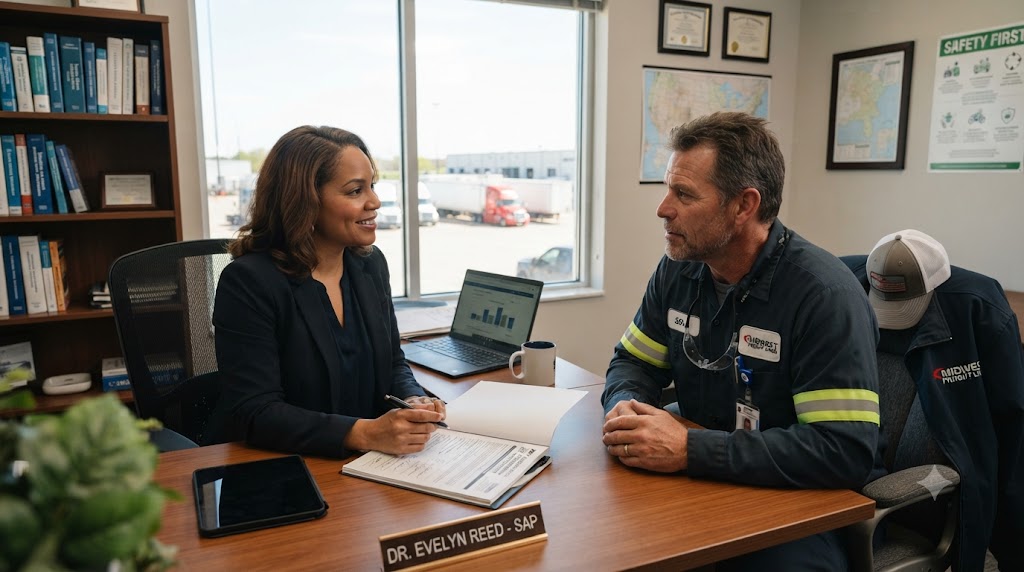
A violation is not automatically the end of a driver. It is the start of a documented process — SAP evaluation, education or treatment, an observed return-to-duty test and a follow-up schedule that has to be tracked for years.
The moment a driver has a verified positive, a refusal, or a confirmed alcohol result of 0.04 or higher, they are immediately prohibited from performing any safety-sensitive function — for you or for any other DOT-regulated employer. The violation goes on the Clearinghouse record. It stays there, and the prohibition stays in force, until the driver completes the return-to-duty process in full.
You have obligations too. You must immediately remove the employee from safety-sensitive duty and provide them with a list of qualified Substance Abuse Professionals. That obligation exists whether or not you intend to keep them employed.
Follow-up testing is where programs fail. The RTD test is a single event and easy to remember. A five-year follow-up schedule, unannounced and directly observed, is not. Missing follow-up tests is a serious finding — and if the driver moves to a new employer, the remaining schedule travels with them.
A SAP cannot have a financial or referral relationship that compromises independence, and the SAP who evaluates a driver may not also provide the treatment they prescribe unless specific conditions are met. This is why we provide a list of qualified SAPs rather than steering you to one. IPS administers the process; the clinical judgement stays independent, exactly as the rule requires.
We manage everything around the clinical work: providing the compliant SAP list, tracking the driver's progress through the process, arranging the directly observed return-to-duty test once the SAP releases them, loading the follow-up schedule into your program, running each unannounced follow-up test on time, and reporting the negative RTD result and follow-up completion to the Clearinghouse.
If a driver joins you mid-schedule, we obtain the existing follow-up plan and pick it up rather than starting over — a transfer that goes wrong more often than it goes right.
You still must remove them from safety-sensitive duty, provide the SAP list and report the violation. What you are not required to do is return them to work. Terminating instead of rehabilitating is your call as an employer — but the reporting and referral obligations do not disappear with the employment.
The clinical work stays with the SAP. Everything around it is ours.
A compliant list of independent Substance Abuse Professionals, provided the moment a violation is verified.
Evaluation, prescribed program and follow-up evaluation tracked so nothing stalls silently.
Directly observed return-to-duty collection arranged at a certified site once the SAP releases the driver.
Minimum six tests in 12 months, unannounced, tracked for the full duration the SAP prescribes.
Driver joining mid-schedule? We obtain the plan from the previous employer and continue it correctly.
Negative RTD results and follow-up completion reported so the driver's record clears properly.
Every step documented, every deadline held — including the ones years away.
6+
Follow-up tests in year one
5yr
Maximum follow-up period
The driver is removed from safety-sensitive duty and the violation is reported to the Clearinghouse.
You meet your obligation to supply a list of qualified, independent Substance Abuse Professionals.
The SAP evaluates the driver and prescribes education, treatment, or both. We track completion.
A follow-up evaluation produces the written report releasing the driver for a return-to-duty test.
A directly observed test, ordered by the employer, with a verified negative result required.
At least six observed tests in 12 months, unannounced, potentially continuing up to five years.
A qualified professional — meeting DOT credential and training requirements — who evaluates employees who have violated a DOT drug and alcohol regulation, prescribes education or treatment, determines when the employee may return to duty, and sets the follow-up testing schedule.
No. A driver with an unresolved violation is prohibited from performing safety-sensitive functions for any DOT-regulated employer until the full process is complete, including a verified negative directly observed return-to-duty test.
DOT rules do not assign the cost. It is determined by your company policy, any collective bargaining agreement, or state law. Many employers place the cost on the employee. Whatever you decide, put it in your written policy in advance.
The SAP determines the schedule, but it must include a minimum of six directly observed tests within the first 12 months after the driver returns to duty. The SAP may extend follow-up testing for up to five years.
The remaining follow-up schedule follows the driver. The new employer must obtain the SAP report and continue the schedule. IPS obtains and continues these plans when a driver joins one of our clients mid-schedule — a handover that frequently goes wrong.
Yes. Both the return-to-duty test and all follow-up tests must be conducted under direct observation. This is not discretionary.
Still have a question? Call 248-526-9000 or send us a message.

We manage the return-to-duty process end to end — including the follow-up schedule everyone else forgets.
We reply the same business day. No setup fees, no long-term lock-in.
Your email client should have opened with the details filled in. If it didn't, email us at info@ipsdrugtesting.com.